
What Are the Early Signs of Macular Degeneration?
Updated: Jun 3
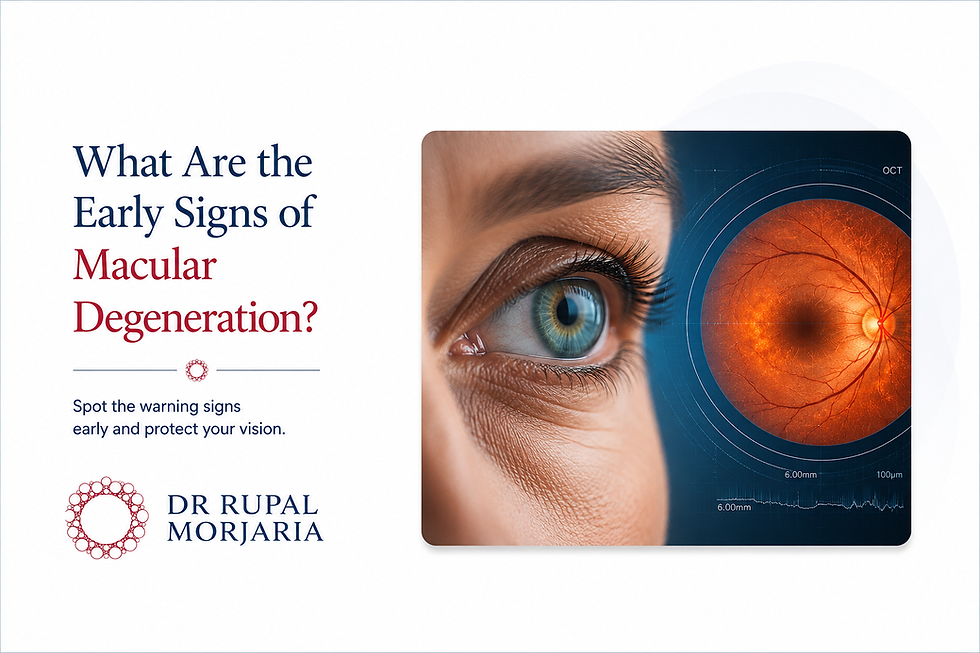
Macular degeneration is one of the most common causes of changes in central vision that I see in clinical practice.
One of the challenges with the condition is that the earliest symptoms can be subtle. Many patients initially assume that changes are simply part of ageing, tiredness, or a need for new glasses.
However, recognising the early signs of macular degeneration is important because early assessment and timely management can make a significant difference to long term visual outcomes.
Understanding what to look for can help ensure that changes are identified and investigated as early as possible.
⸻
What is macular degeneration?
Macular degeneration affects the macula, which is the central part of the retina responsible for detailed vision.
The macula allows us to read, recognise faces, drive, and carry out many of the activities that require sharp central vision.
As macular degeneration develops, the ability of the macula to function normally can become affected.
This may happen gradually over time or, in some cases, more rapidly depending on the type of macular degeneration involved.
⸻
What symptoms should you be aware of?
The earliest signs are often not dramatic.
Many patients describe subtle changes before they notice any significant loss of vision.
Common symptoms include:
• Straight lines appearing bent, wavy, or distorted
• Difficulty reading smaller print
• Needing brighter light for reading or close work
• Reduced clarity when recognising faces
• Colours appearing less vivid than before
• A blurred area developing in the centre of vision
• One eye appearing weaker or less clear than the other
One of the most important signs that I encourage patients to pay attention to is distortion.
If door frames, window frames, or lines of text begin to appear bent or irregular, this should always be assessed promptly.
⸻
Why early recognition matters
One of the reasons I place so much emphasis on early assessment is that not all forms of macular degeneration behave in the same way.
Dry macular degeneration tends to progress more gradually.
Wet macular degeneration can develop more quickly and may require treatment to help protect vision.
The earlier changes are detected, the sooner we can determine what type of macular degeneration is present and what level of monitoring or treatment may be required.
What I often explain to patients is that we cannot always restore vision that has already been permanently lost, but we can often take important steps to preserve the vision that remains.
This is why timing matters.
⸻
What should you do if you notice these symptoms?
If you notice any of the symptoms described above, I would recommend arranging an eye assessment as soon as possible.
In most situations, I would advise:
• Paying attention to any distortion or changes in central vision
• Comparing vision between both eyes individually
• Seeking assessment promptly if symptoms develop suddenly
• Not assuming that new glasses alone will solve the problem
• Attending regular eye examinations, particularly if you are over the age of fifty
A specialist retinal assessment allows me to examine the macula in detail and identify even very early changes.
Using advanced retinal imaging such as OCT scans, I am able to assess the health of the macula with a high degree of accuracy and determine whether monitoring or treatment may be appropriate.
⸻
Why choosing the right specialist matters
Macular degeneration is a highly specialised retinal condition.
Understanding whether changes are present, how advanced they may be, and whether treatment is required relies on detailed assessment and interpretation.
In my practice, I focus on:
• Extensive experience in medical retina conditions, including both wet and dry macular degeneration
• Detailed retinal imaging and OCT interpretation
• High volume experience in retinal treatments, including injections where appropriate
• A personalised approach focused on protecting long term visual function
I understand that many patients feel concerned when they begin to notice changes in their vision.
My role is to provide clarity, reassurance, and an evidence based plan that helps patients understand both the condition and the options available to them.
⸻
The bottom line
Macular degeneration often begins with subtle changes that can easily be overlooked.
The most important points are:
• Early symptoms may include distortion, blurred central vision, and difficulty reading
• Straight lines appearing wavy should always be assessed promptly
• Early detection allows appropriate monitoring and treatment where necessary
• Specialist retinal assessment is important in understanding the condition fully
Often, the most important question is not:
“Is this just part of getting older?”
But rather:
“Could these changes be an early sign that my macula needs attention?”
⸻
Considering your next step
If you have noticed changes in your central vision, or if you are concerned that you may be experiencing early signs of macular degeneration, a specialist and tailored assessment can provide valuable reassurance and clarity.
Macular degeneration requires careful evaluation to determine whether changes are present, what type of condition may be affecting the retina, and whether monitoring or treatment is appropriate.
A consultation with me will provide:
• A detailed retinal examination supported by advanced imaging
• A clear understanding of the health of your macula
• Expert guidance on whether monitoring or treatment is required
• A personalised plan focused on protecting your long term vision
If you would like clarity, reassurance and a plan you feel confident in, I would be very happy to see you in clinic and guide you through your options.
Contact details and appointments, click here.


Comments